The return of hands-on beauty
The modern beauty landscape has never been more abundant. Serums are formulated with laboratory specificity, at-home devices borrow the vocabulary of the clinic, and high-tech tools promise professional results from the bathroom counter. Routines that once required three steps now require ten.
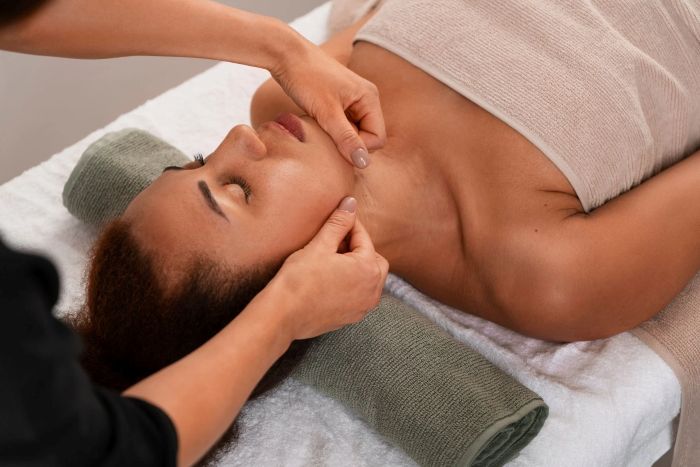
Yet amid this abundance, a counter-movement has quietly taken hold. The most sought-after element in a treatment room is often not a formula or a machine but a pair of highly trained hands. Hands-on facial work has returned to the conversation as a discipline in its own right, one that values precision, anatomical understanding and time.
Facial massage itself has matured. It is no longer a single, standardized ritual offered as a pleasant finale to a facial. It has become a sophisticated category with distinct schools of thought, and within it, a handful of specialized techniques are drawing particular attention.
Facial massage is not one technique
“Facial massage” now describes a family of approaches rather than a single practice, and the differences between them are more than cosmetic.
Relaxation-focused massage relies on slow, rhythmic strokes that invite the nervous system to settle. Sculpting-inspired techniques use firmer, more deliberate movements that trace the architecture of the face. Lymphatic-inspired approaches favor feather-light pressure and precise directional flow. Myofascial work moves more slowly and deliberately, engaging the connective tissue beneath the skin.
Then there is buccal and intraoral massage, where the practitioner works not only on the outside of the face but also from within the mouth.
None of these approaches needs to be viewed through the lens of better or worse. They simply represent different techniques, priorities and practitioner philosophies. Understanding that variety helps explain why facial massage has become such an interesting part of the contemporary beauty conversation: there is no longer one definition of what a facial massage has to be.
What makes buccal massage different?
“Buccal” refers to the cheek. In buccal massage, the practitioner works on the face from two directions at once: across the outer surface of the skin, and from inside the mouth along the inner cheek.
The session typically moves between two modes. The first resembles an expert facial massage, with the hands working across the contours of the face. The second is more distinctive. Wearing gloves, the practitioner places their fingers inside the mouth and works on the inner cheek while the other hand works in concert on the outside. The muscle is held and addressed between both hands.
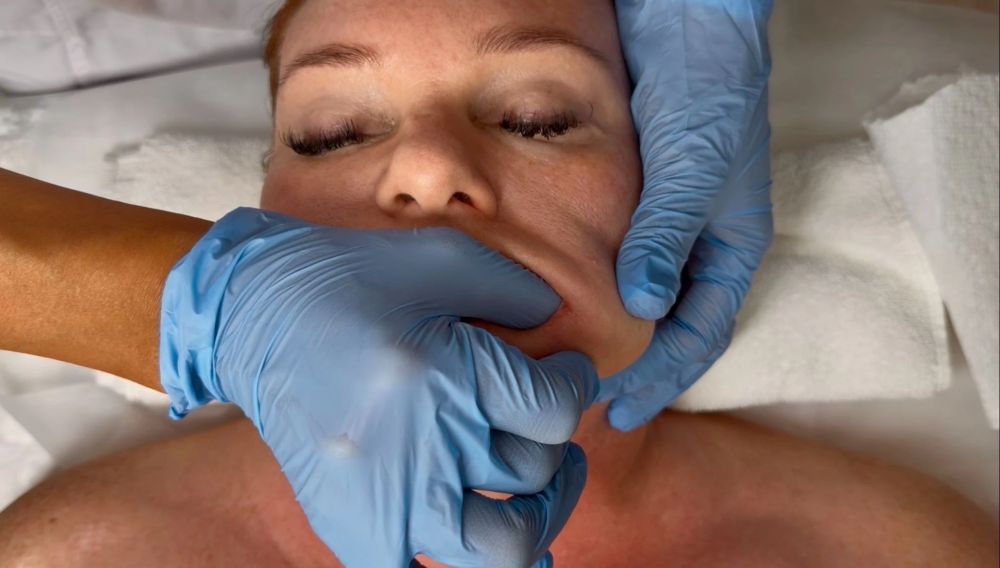
The focus falls on the cheeks, the jaw and the lower face. These areas are home to the layered muscles we use to chew, speak and express emotion, and they are largely out of reach from the surface alone. The internal and external movements are not separate steps. They are choreographed to work in relation to one another.
This is why buccal massage demands a level of precision that conventional facial massage does not. Working inside the mouth is intimate, delicate contact that requires exacting control of pressure, placement and timing, along with rigorous hygiene and a high degree of trust between practitioner and client. It is a distinct technique with its own logic, not an intensified version of a familiar one.
Buccal and intraoral massage: a distinction worth making
The two terms are often used interchangeably, but practitioners who specialize in this work draw a meaningful line between them.
Buccal massage works on the muscle itself: its body, its tone, its texture. Intraoral massage, in its more specialized sense, shifts attention to a different point entirely, the place where the muscle attaches to the bone.
The reasoning is structural. In this view, the muscles of the face and the bones of the facial skull exist in constant dialogue. When a muscle holds tension, that tension is transmitted to the bone it anchors to, and practitioners note that the relationship can also run in the opposite direction. The attachment point, where this exchange is concentrated, is regarded as the area of greatest tension. It is precisely there that intraoral work directs its focus.
The distinction may sound subtle, but it changes the entire character of the session. Where buccal massage addresses the muscle, intraoral massage addresses the junction between soft tissue and structure. That calls for an even finer understanding of facial anatomy and an even more measured touch.
Why technique matters
In any hands-on discipline, the practitioner defines the experience. In intraoral work, that influence is magnified.
Pressure must be calibrated with care, because what feels comfortable on the outer cheek can register very differently from within, and attachment points are especially sensitive. Hand positioning requires the coordination of two points of contact simultaneously. The sequence of movements, including where a session begins, how it builds and how internal and external work flow into one another, determines whether the treatment feels coherent or disjointed.
Beneath all of this lies a working knowledge of facial anatomy: how the face is layered, where muscles originate and attach, and where restraint matters more than force. Communication is equally essential. Because clients cannot easily speak during intraoral work, experienced practitioners establish signals in advance and check in between phases, adapting each session to the individual’s comfort and preferences.
For these reasons, intraoral massage is not a technique to learn from a short video. Its value lies in trained hands and informed judgment, and that cannot be reduced to a DIY routine.
The experience behind the technique
Beyond its technical dimensions, intraoral massage is a profoundly tactile experience. For most people, having the face approached from within is entirely new, and the initial unfamiliarity often gives way to deep absorption.
The pace is deliberately unhurried. A session does not rush through a checklist. It unfolds gradually, guided by the practitioner and responsive to the client at every stage. That slowness is part of its appeal: a rare interval in which attention is devoted entirely to the face and to the sensation of being expertly cared for.
This is where the distinction between at-home rituals and professional hands-on work becomes most apparent. A facial roller or a few minutes of self-massage can be a lovely daily habit. A practitioner-led session offers something of a different order: expertise, personalization and a quality of attention that is difficult to give oneself.
Seen this way, intraoral massage belongs to a more considered culture of self-care, one defined not by speed or convenience but by intention.
Expert perspective: why specialized facial massage is gaining attention
As specialized techniques move into the mainstream beauty conversation, practitioners emphasize that the difference lies less in the movements themselves than in the understanding behind them.
As Dinara, Beauty esthetician at TheArtFace, explains:
“Conventional facial massage primarily works from the surface. With intraoral work, the practitioner can approach the tissues from inside the mouth as well, which creates a very different relationship with the structures of the face. It requires a detailed understanding of facial anatomy, precise technique and an attentive touch. Every face is different, so the work needs to be adapted to the individual, with communication and comfort remaining essential throughout the session. I think that personal element is part of what makes the technique so interesting: it feels less like following a standard routine and more like responding to the individual face.”
Conclusion
Buccal and intraoral massage may never be as familiar as a jade roller, and that is precisely the point. Their growing visibility speaks less to a single technique than to a broader evolution in how we think about beauty.
The widening range of facial massage approaches reflects a shift toward personalized rituals and away from one-size-fits-all routines. Modern facial massage increasingly unites technique, practitioner expertise, wellness and individual preference. In a market saturated with products and devices, the renewed value placed on skilled human touch may be its most compelling development.